So, the pecking order has become imbalanced in your house, and the dog has determined he’s ruling the coop.
Not a fun place to be. You’re probably scratching your head wondering where you messed up, and if you need to make that dreaded call the vet to schedule a neutering appointment. That is if your dog is still intact. But, imbalance of the pecking order can happen with neutered and even female dogs.
Before making any rash decisions or making any big changes to your dog’s life, take a step back and ask yourself these questions:
- Is there a clear alpha in control when it comes to the dog?
- What this means is, is there someone who takes an authoritative stance over the dog and their behavior. This person would do the majority of the feeding, the majority of the discipline, and also clearly shows the dog their place, which goes to question 2.
- Is the dog being engaged before other family members?
- Think back to when you get home (or your partner) and the dog is SO excited to greet you. Do you (or your partner) greet the dog first, or is it the family members in your home.
- Does your dog have their own space?
- If your dog is kennel trained and loves their kennel, this is their space as long as it’s accessible. If your dog doesn’t have a kennel, do they have somewhere or something (ie. dog bed) that is theirs only, and are not bothered when there.
- Does your dog have a job?
- Dogs have an extreme sense of duty, especially if you’re handling with a working breed. If they do not have a job assigned to them, they will assign one themselves. And it’s usually not one you favor, like digging holes in the yard.
Each of these questions when answered honestly will show you where you need to reconstruct… structure! With your dog.
Once you’ve determined there’s some work to do to get your pecking order back in line, now what?
Breaking it down by each question, try implementing these recommendations:
- Have one person (preferably an adult with homes with kids) do the majority of the feeding. This plays to the old rule, dogs don’t bite the hand that feeds them. But it’s more than that. This person should also be the one that is working skill building with the dog every day, even if it’s only for a couple minutes.
- Always greet the humans in your home before your dog. Always. Even better, greet them in their “pecking order”. This will reinforce the dogs place in his pack.
- Get your dog their own designated space that is truly theirs. Then try not bugging them when they are there. This will help them know they can go somewhere when they are tired or feeling anxious.
- Assign your dog a job. Or multiple jobs. Jobs can be anything from working on the farm, hunting related, play related, household duties – like picking up after themselves, to support services. No dog is too old to learn a job, just find the one that fits your dog best.
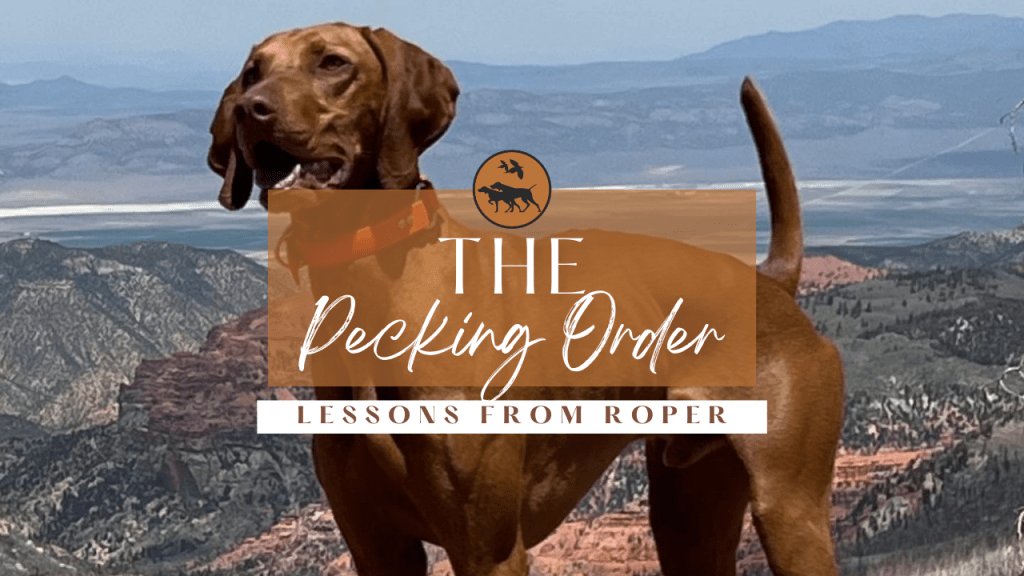
So who am I to offer advice on getting your pecking order back in line? I am co-owner to a very strong-willed male Vizsla named Roper (meet Roper here).
Roper is 3 years old and is still intact for many reasons, and one day I’ll write on that, but not today. We never thought that our easy going, people pleaser, hard working dog would ever try to become the alpha male in our home.
This came about after moving for the third time by the time he was two, and losing his older canine sister to cancer. So needless to say, the structure we had raised him on in his puppy years had pretty much demolished.
We were over compensating with affection after the loss of our older dog, and wanted Roper to feel loved. We started a new feeding routine, it was the off-season of hunting, all of these things were adding up, and Roper didn’t like it. And he was going to change things himself.
It wasn’t pretty at first, he started resource guarding our things – like the blanket it on the couch. Stopped eating the amount he needed to be for his activity level, and just not listening worth a damn.
So as I mentioned before as a recommendation of taking a step back. That’s what we did.
We examined everything about the structure around Roper, and we ultimately realized we were to blame. Shocking, right?
The first thing we changed was putting in place a feeding routine where Gage was the one delivering the food. Since Roper is home with me every day, we felt that he needed to view Gage as an authoritative figure in the home again, and not just out in the field.
Which lead us to the second thing we changed, how he was engaged. Roper loves affection, especially when his dad gets home from work. It used to go Roper, then me that is greeted. Once that was changed, Roper quickly learned that his place comes after me. Flash forward to a year later, Roper still gets excited when his human gets home, but respects the order of greetings and knows once it’s his turn, he gets to work.
This one was strange for us because Roper does have a job. He hunts. However, what we didn’t think about was the few months where there is nothing going on, no birds, no big game, not even antler gathering. Roper felt lost and we weren’t suppling him with an outlet to still use those skills. Once we started giving him the opportunity to use those skills (we’re fortunate enough to have a big yard he can run in), he started thriving in the off season. His favorite is watching the birds eat from the feeder. side note, this has been great for his pointing game. And of course his second is a good game of fetch. Everyday he gets to play fetch, and every day we ask him to go find the birds. These little changes completely changed his character.
The last big change we incorporated was making sure he had a place of his own. After outgrowing his second kennel, he decided he didn’t need one anymore. Which meant he no longer had his own space. We gave him his space back by building him a bed, as well has giving him a comfy spot in his favorite room of the house – the hunting gear room. Having two places to escape to, and he knows his time will be respected, has allowed him to regain his peace that was lost.
Of course, all of these are recommendations and just because they worked on Roper, doesn’t mean they will work for you. What will is taking the time to observe and reflect on yourself, and the structure you’ve built around your dog. If you are ever concerned, never hesitate to work with your trusted vet for what is best for your dog and your household.
 The Copper Dogs